410 Award Exhibitions
Art Gallery 410GALLERY
EXHIBITION #08

The Beast in the Palm of Your Hand
YUYA SHIRATORI
2026.03.22 - 03.25
Memories you can touch.
The form of feelings.
A beast residing in the palm of your hand.
Yuya Shiratori
Born in Kanagawa Prefecture in 1986.
Representative of UNKNOWNWORKS
In addition to his landscaping business, he creates sculptures from felled trees and waste materials.
I create works that intertwine nature and the inner world of humanity.
After studying sculpture and spatial expression in the United States and Thailand, I returned to Japan and participated in solo exhibitions, group exhibitions, and open call exhibitions.
They also engage in performance activities that incorporate dance and music, exploring the possibilities of expression across genres.
"Horned beasts" carved from trees
The artworks evoked the illusion of a space teeming with extraterrestrial creatures that humanity might reach in the distant future. And what's more, they were carved from trees on Earth. Touching them, you feel their warmth, and the realization that they might be living beings becomes overwhelming.
The artist named it "Horned Beast." "Horned Beast" represents the strong thoughts lurking deep within human beings, and the friction and harmony that arise when people and society confront each other. The artwork expresses these invisible things in the form of a beast with horns.
The horns that serve as the motif are primarily the cave horns found in bovine animals. Bovine horns are directly connected to the skull and continue to grow throughout life. The artist feels that their structure and nature embody not mere decoration, but a strong will to survive.
The "horned beast" is a being that symbolizes the "informative impulses" and "emotions before they can be put into words" that reside within people.

Sai

Koku

Yu
The origin of the palm-sized beast
One piece that particularly caught the eye was titled "Kan" (環). Two heads, each with a single horn, are fused together on the front and back, with the horns forming a ring about 1 meter in diameter. It was made using wood from a camphor tree, a sacred tree at Daiyuji Temple in Yanaka, Taito Ward, Tokyo, which had its branches pruned for treatment.
I've always been interested in "horns." The logo of my father's baby products company is based on a moose, and I grew up seeing it from a young age. My exposure to the ritualistic worldview of the indigenous peoples of America and Canada, which involves respect for animals, also became one of the backgrounds for my thinking about "horned beasts." That is the origin of "Palm-Sized Beasts." While running a landscaping business, I continue to create such works using felled trees and waste materials.

Yuya Shiratori touches upon "Kan"

forget-bou-
Learning and setbacks in America and Thailand
As a child, I loved Lego blocks. I didn't read the instructions; I just assembled them however I wanted. In middle and high school, I drew detailed illustrations, but I also played electric guitar and sang in a punk band. After graduating from high school, I went to America and attended art school in Boston.
I studied graphic design, printmaking, and sculpture, and through a teacher's introduction, I went to Chiang Mai, Thailand. There, I encountered bamboo crafts. Inspired by the system of using the abundant bamboo in the mountains to create local crafts, I returned to Boston and began to think, "What can I do here?"
Walking around the city, you see a lot of bicycles. In fact, Boston is known as a bicycle-friendly city, with dedicated lanes and plenty of rental options. While observing, I noticed that punctured tires were being discarded. "Thai bamboo is Boston's tire," I thought... I immediately made a recycling box to collect the tires. I wove them together to make baskets. That's where the origin of creating things using waste materials lies.
During my five years in America, I experienced setbacks. At my new school, I studied welding, but I spent day after day working in the basement. I was discouraged by my lack of experience and returned to Japan. After spending some time at home, I worked as a designer at an Asian goods store. I joined my father's company, but it didn't work out.

spring-you-

Swamp-shou-

overflowing -itsu-
I feel dead if I'm not exposed to art.
What do I really want to do? I kept thinking about it in my room, and then I suddenly clutched an old piece of artwork I'd made, and there I was. I realized that I was dead if I wasn't involved with art. While working in archaeological excavations and landscape gardening, which I had always been interested in, I began to create my own artwork.
My sources of inspiration are diverse. I might ask the people who serve as my models about their lifestyles, or I might confront my own inner self and emotions. Sometimes I give form to the energies of nature, such as water, wood, and light. Lately, I've been creating many "pairs" of works, which is because I feel the importance of human relationships and dialogue.
He admires Taro Okamoto and Isamu Noguchi. His goal for the future is to create a park filled with outdoor artworks that people can touch.
(Writer: Ramon Todo)

Yuya Shiratori touches upon "Kan"

Ai

Ring -kan-III

Ai-II

Colorful, palm-sized creations made with 3D printers are also available.


EXHIBITION #07

The World of Paper Cutting Exhibition
Kiri - shi Nagaya Akira
2026.01.08 - 01.11
These paper-cut artworks, with their delicate 0.2mm lines, exude a striking presence.
By displaying the artwork in a frame, as if it were gently floating, the lines separate from the paper and sway lightly, as if enveloped in air itself.
Its delicate nature evokes the beauty hidden within nature.
It's a work where air and light come together in harmony.
profile
Born in Nikko City, Tochigi Prefecture in 1967.
In 1988, captivated by the exquisite beauty of the bamboo leaf decorations made by sushi chefs, I began to teach myself paper cutting.
2008: First solo exhibition, "Akira Nagaya: The World of Paper Cutting," Suginamiki Gallery/Nikko City, Tochigi Prefecture.
2012 Solo Exhibition "NY Paper Cutting Exhibition" SOMETHIN'Jazz gallery/NY, USA
2015 Solo Exhibition "Miracle Paper Cutting Exhibition" Tokyo International Forum/Chuo-ku, Tokyo
Invitation to the "Star Wars: The Force Awakens" Release Commemorative Artist Project, Roppongi, Tokyo
2016 Invited to "Sharaku-Inspired Exhibition" Shinjuku Gaien/Shinjuku, Tokyo

The masterpiece "Sharaku" and Akira Nagaya
It's practically "divine skill"—no one believes it's paper cutting. Kiri-shi by Akira Nagaya
The moment I heard the word "paper cutting," I shivered.
Even if someone told me it was a "paper cutout," I'd find it hard to believe.
Sharaku's masterpiece depicts even the hairline and wrinkles of the kimono with exquisite detail. Turning to the next work, the long hair of a kabuki actor striking a pose on stage seems to move like a living thing, strand by strand. The calligraphy, inscribed with the words "The Great Ocean," exudes the aura of a master, with its exquisite ink washes.
If left unexplained, these would appear to be exquisitely designed, ultra-fine pen drawings and calligraphy. That's all they look like. Anyone who sees them would say, "These are wonderful works of art." However, the moment you hear that they are all paper cutouts, you'll shudder.
"What? No way... How on earth?"

The vast ocean

4th generation Kabuki
I was captivated by the skills of the sushi chef.
When I was 20, I was captivated by the "sasa-giri" technique used by a chef at a local sushi restaurant where I was working part-time. This traditional technique involves cutting slits into bamboo leaves with a knife to create auspicious shapes such as cranes and turtles, which are then used to decorate sushi.
Thinking that I might be able to do it too, I tried it with a utility knife and paper, and surprisingly, I could do it. Without even realizing that what I was doing was "paper cutting," I continued doing it for fun and gradually improved.
After graduating from a technical high school, he joined Nikon, a major optical equipment manufacturer. He worked on making parts for specialized products supplied to organizations like NASA in the United States. "I was good at detailed work, and I think I had a good intuition," he recalls. After working there for three years, he started helping out at the souvenir shop his father ran in Kinugawa Onsen (Nikko City, Tochigi Prefecture). Later, he expanded the business to include shooting galleries, ski rentals, and an insurance agency.
During that time, for about 20 years, paper cutting was purely a hobby. "I thought it was embarrassing and outrageous to talk about art." Not knowing that there were mats to place under the cutter, she worked using newspapers and magazines as a base. She also didn't know about spray glue, and often ended up with wrinkled pieces when she used regular glue to attach them.

Some works were created by cutting out iron with a laser.

Dragon painting

Explanation of the "Dragon Painting"
Amidst the Great East Japan Earthquake and the COVID-19 pandemic...
Through self-study and trial and error, she gradually established her own style. In 2008, she held her first solo exhibition in her hometown and began her career as a paper-cutting artist. However, in 2011, the Great East Japan Earthquake caused a drastic drop in customers to her shop, forcing her to close it down.
While wondering what he needed to do, an acquaintance invited him to "go to Tokyo and try working as a writer," so he moved to the capital. In 2013, his work was featured in the photo spread of "Weekly Asahi," and he began receiving numerous requests to appear on television programs, causing his popularity to skyrocket.
Just when things were looking up, the COVID-19 pandemic, which began at the end of 2019, forced the cancellation of all solo exhibitions and events. However, she didn't give up, and while working, she continued to create and exhibit her work, winning awards at the "Tokyo World Exhibition Rambouillet 2022" and the "Japan-France Contemporary Art Exhibition" (2023). This led to her current award.

Wild

Twilight

Alto saxophone

"Bear"
There are several bear patterns hidden within.
With copy paper and an inexpensive utility knife
The works are diverse. This year's award-winning piece, "KAEDE," is based on a withered maple leaf, with gold leaf applied to the back. The gold leaf reflects off the white background, casting a faint color in the shadows. A small bird is hidden within the leaf veins, allowing for a kind of trick art enjoyment.
In addition, he displays large motorcycles, cats, teddy bears, trumpets, saxophones, and other items, and he has about 200 works in his possession. Each piece is mounted on an acrylic panel attached to a glass case, making it appear as if it is floating in mid-air, and the shadows it casts are also very effective.
Simply pasting the artwork onto a backing board makes it look like a pen drawing or calligraphy. Ironically, this technique was developed because the artwork was often so perfect that people said, "It doesn't look like paper cutting."
The paper used is basically copy paper. If it's too thick, it doesn't cut well, so after trying various types, I settled on copy paper that is 0.1 mm thick. The tool is a commonly used, inexpensive utility knife. With that in hand, I cut it into extremely thin strips, as thin as 0.2 mm wide.
It takes anywhere from three months to a year to create one piece. I've failed countless times, but I've learned to believe that each failure means I can do better next time.
2026 is a crucial year for him. Having overcome two major difficulties, he will challenge the world once again with the methods he has forged for himself. He is determined to "awaken the art of paper cutting."
(Writer: Ramon Todo)

"KAEDE," winner of the 410Gallery Award.


EXHIBITION #06

Shioya
Kotorinoko
2025.03.20 - 03.23
Salt has been a familiar part of our lives for a long time, but depending on the amount we use, it can be either just right or too much.
This time, we will be showcasing the fascinating people and products related to "salt."
I hope you can find the perfect balance.
Kotorinoko
Kotori no Ko / Artist
profile
Based in Fukuoka. Majored in graphic design at university and studied more comprehensive, socially relevant design in graduate school. Since childhood, drawn to the ambiguity, mystery, and nostalgia of picture books, she has been creating works centered on illustrations and stories.
Born in Fukuoka City, Fukuoka Prefecture in 1998.
Graduated from Kyushu University, Faculty of Design, Department of Image Design in 2021.
Studying abroad at Aal University, Finland in 2022 (1 year)
Completed the Design Strategy program at the Faculty of Design, Kyushu University in 2024.

The masterpiece "Sharaku" and Akira Nagaya
Right or wrong? Kotori Noko stirs up trouble with the "just right" of salt.
If you see it once, it's sure to appear in your dreams.
A boy-like figure is rubbing salt into a bright red scrape on the knee of a large man. The title is "The Man Rubbing Salt into the Wound." The boy holds a jar of salt, his eyes expressionless as he concentrates all his attention on his fingertips.
The title of the work displayed alongside it was "The Man Who Carefully Nurtures." In this one, a large figure sprinkles salt on a boy, and the salt piles up like a mountain on his head. Neither painting shows the large figure's face. The viewer's gaze is drawn to the boy's expressionless eyes.
The title of the solo exhibition is "Shioya" (Salt Shop). It's certainly strange, but Kotori Noko's extraordinary imagination is evident in her focus on salt, a compound essential to human life.
The phrase "rubbing salt in a wound" was inspired by a casual conversation within the family. Upon investigation, I discovered that the variations of words using salt were far greater than I had imagined. "Meek," "sending salt to the enemy," "a person who has lost their saltiness," "cold treatment"... and "just right" (anbai).

A person who cherishes and nurtures

A person who rubs salt in the wound

"Salt Face Water" trilogy

Salt Face Water product packaging

Salt Face Water Product Advertisement
"I like words that don't lean towards either good or evil."
Originally, she "liked words that didn't lean towards either good or evil." She attended Christian schools throughout middle and high school, and although she wasn't a believer, she naturally developed a sense of religion. She also became interested in the archaic smile of Buddhist statues, which originated in ancient Greece. While the emotional expression on the face is kept to a minimum, the mouth alone seems to be smiling. Perhaps the unobtrusive style of expression of the writer Kotori Noko has its origins in this.
The most prominent example of this is the three-part series titled "Salt Face." Below each artwork is an advertisement for a fictional product called "Salt Face Water." It depicts a figure with an expressionless, smooth face, accompanied by the taglines "A new era, pursuing lightness," "For the face," and "We saw results."
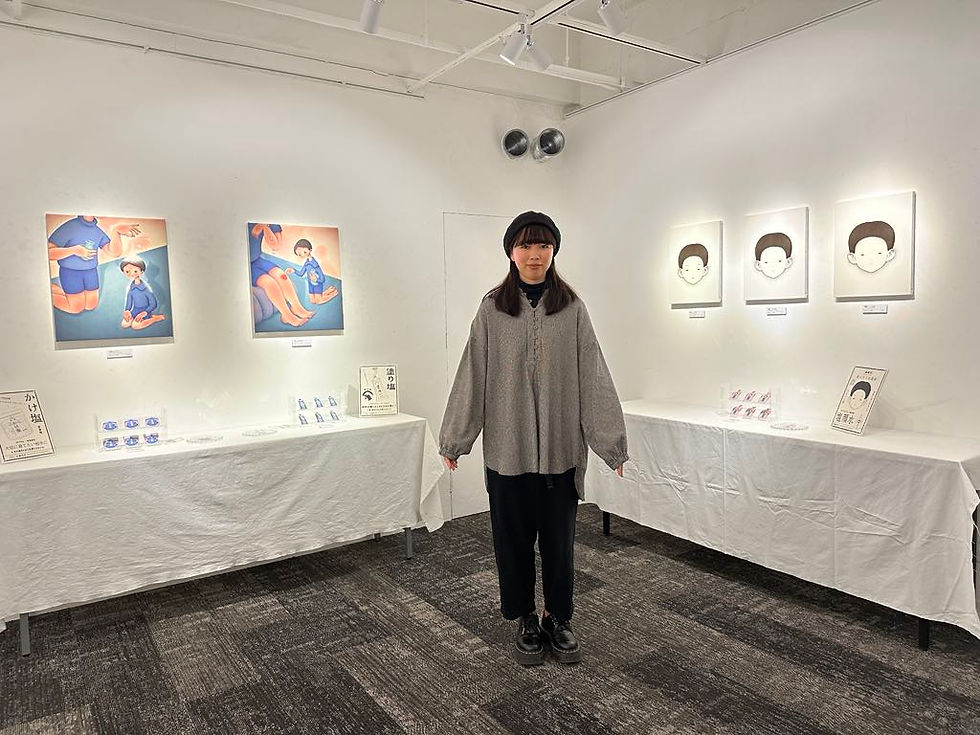
Kotori Noko standing in the exhibition hall

Salt-faced look, 1 month later

Salt-faced look, 2 months later

Salt-faced look after 3 months
This can now be described as horror.
The person with the salty face shows changes in their facial expression one month, two months, and three months after using the salty face water. After three months, their eyes, nose, and mouth all become smaller and less defined... This is practically horror. It's no wonder that the creator is a fan of horror manga artists Junji Ito (known for "Tomie" and "Uzumaki") and Kazuo Umezu (known for "The Drifting Classroom" and "Makoto-chan").
This salt-based facial water has another surprise. The creator designed the product packaging and even made the stickers for it. Having studied animation, video, CG, and projection mapping at Kyushu University's Faculty of Design and Graduate School, it's impressive that they were able to create such an appealing product, even if it's fictional.
His artwork "A Toy for Making Shed Skins," inspired by his childhood love of collecting insect exoskeletons, is also interesting. It depicts a boy looking somewhat pleased with the exoskeleton of a creature resembling a newt, and the accompanying text reads, "Using this exoskeleton liquid, you can create exoskeletons in any shape you like."

Toys that make shed skins

A spray bottle that makes noise

A child being bitten by a mosquito
I kept saying I wanted to become a children's book author.
From "Mama Spray," a spray bottle that makes the sound "M" when sprayed, to "Child Being Bitten by a Mosquito," which expresses the idea that it's cruel to kill a mosquito that bites your face, these original works, which no one else would have thought of, make you want to look at the details again and again.
Since kindergarten, I've always said I wanted to be a picture book author. I graduated from graduate school in March 2024 and now I spend my days working part-time while creating my own works. I look forward to the release of my new work that will stir people's hearts. (Writer: Ramon Todo)
410Gallery YouTube channel "RIS410" #02 Interview with Kotori Noko → Click here


EXHIBITION #05

architecture 2.0
The mischievous middle-aged man Tonomaru's extreme "craft" exhibition
2024.10.03 - 10.06
An art activist who calls himself a "world-class craftsman."
Using the arts and crafts I experienced as a child as a method of expression, I engage in extreme "crafts" day and night, cleverly exploring the intersection of crafts and art. I create installations using everyday objects, photographs of the city, and works that are not bound by technique or skill, with a sense of improvisation.
[Activity History] Solo and Group Exhibitions 2023 FLOW (igu_m_art) PHASE (gallery yongou) 2024 architecture (gallery yongou) un do plus (sweets gallery ℃ sesshi) architecture 2.0 (410Gallery) Art Events and Exhibitions 2023 Independent Tokyo 2023 (Tokyo Metropolitan Industrial Trade Center) 2024 The 1st Matsumoto International Art Exhibition un do Exhibition *Grand Prize Winner (Matsumoto City Museum) BILLIKEN CREATORS OSAKA 4 (Tamura Komu Co., Ltd. Osaka Headquarters) Dynamic Contemporary Artists Exhibition *410Gallery Award Winner (Fukuoka Asian Art Museum) 4 ROOMS ART (Seaside Studio CASO) Ikebukuro Kaiyuha Art Exhibition 2024 (Jiyu Gakuen Ashita-kan) Chignitters ART CAMP (Chignitters) Independent Tokyo 2024 *Tugboat Special Award Recipient (Tokyo Metropolitan Industrial Trade Center) as of 2024

Tomaru, a mischievous middle-aged man whose trademark is wearing a mask.
A delightfully original and playful story that will appeal to the playful side of adults: Mischievous Middle-Aged Man and Tonomaru
Self-proclaimed "world-class craftsman"
These original works, which stimulate the playful spirit of adults, are unforgettable once you see them.
For example, there's a three-dimensional artwork called "DOGLE SUIT." I'm sure I'm not the only one who feels a mystical presence and latent energy emanating from it. When I heard that it was a combination of a Jomon-era "Shakoki Dogu" (goggle-eyed clay figurine) and a mobile suit from the anime "Mobile Suit Gundam," I understood why, but I was also amazed by the concept.
Combining clay figurines, products of a peaceful civilization that lasted for nearly 15,000 years, with mobile suits designed for wear by humans living in space—the meaning of this is unclear. However, one can't help but feel a strange power, a kind of aura, emanating from it.
This flash of inspiration and playful spirit is also reflected in the artist's name. "Tonomaru" comes from Kazuto Tonoma, a character in the baseball manga "Dokaben" by Shinji Mizushima. Tonoma is small for a baseball player, but he has an unconventional batting style and can hit "secret hits," and he is also a first-class pianist. This admiration is what leads to his originality.

The "DOGULE SUIT" exudes a presence that blends the past and the future.

Hana Samurai and His Merry Friends - The Greatest Super
I was born and raised in Osaka. It's probably common in Osaka, the city of comedy, but I loved comedy from a young age and even aspired to become a comedian myself. However, I couldn't keep up with the "athletic, group-oriented" atmosphere. So, thinking that "artistic expression seems to have fewer restrictions," I began creating artwork on my own. That seems to be the origin of my playful spirit.
However, that wasn't enough to make a living. I drifted from job to job, working in photo development, an optician's, and sales for a medical equipment rental company. The turning point came in 2018. My parents, with whom I lived, became frail and needed care. So I quit my job to dedicate myself to caregiving, and at the same time, I started my creative activities in earnest.
Then, the illustration won an award at the Kansai-based open call exhibition "Art Stream 2018." The title was "Hana Samurai and His Merry Friends - The Greatest Supper." The series of parodies began with the silly idea of "what if a samurai's topknot was a flower?", but the expressive characters, including animals, girls, wrestlers, and Kabuki actors, keep the viewer entertained.
I had hoped to build momentum from this, but in 2020 the COVID-19 pandemic hit, and I lost my venue for showcasing my work. On April 8th, the day after a state of emergency was declared in seven prefectures including Osaka, I was struck by the sight of an empty city.
"I never knew buildings could be this beautiful."
From then on, I continued to take photographs every day in the deserted city. I compiled the photos I took on my smartphone over about two years and published them as a photobook called "PRESENCE" in April 2023. It is art that captures the pure beauty of buildings in a city devoid of people, and it is also a valuable book as a record of the pandemic.
This activity, which "changed something within me," must have influenced my creative work as well.
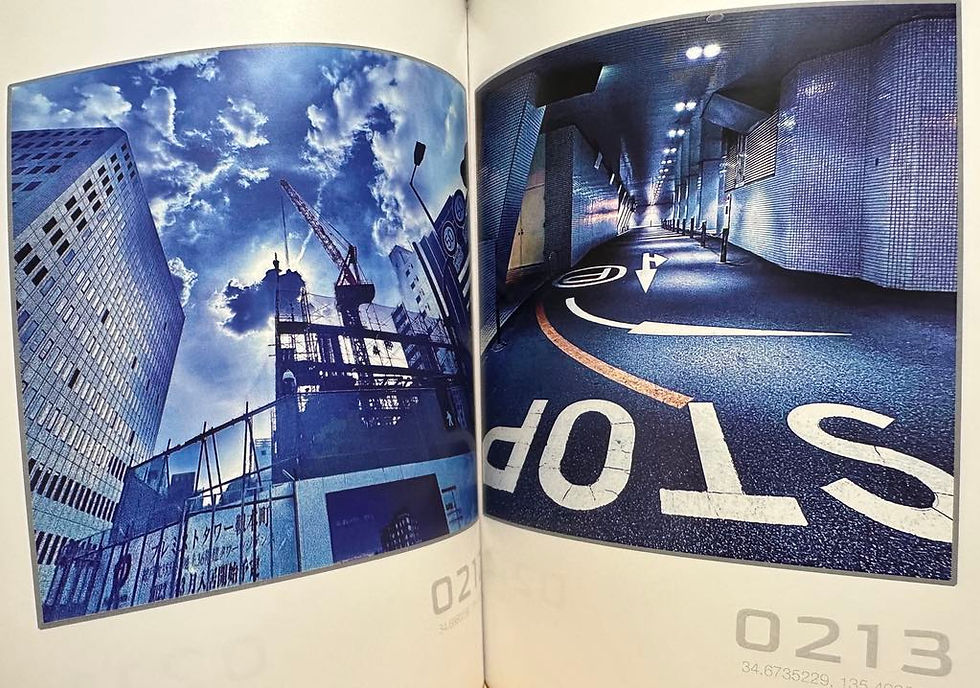
"PRESENCE" is a photo collection capturing scenes of the city during the COVID-19 pandemic.

Expressed through silhouette
"architecture"
He began to focus his efforts on creating a series of works that he named "...".
"DOGLE SUIT" is one such example. In 2024, it won the top prize at the "1st Matsumoto International Art Exhibition un do Exhibition" (Matsumoto City Museum of Art) in Matsumoto City, Nagano Prefecture. The "architecture" series also won the 410 Gallery Award at the "Dynamic Contemporary Artists Exhibition" (Fukuoka Asian Art Museum) in Fukuoka City.

A strange architecture made of stacked dice

Even the business cards are unique works of art.
At his solo exhibition at 410 Gallery, he presented a collection of brilliant works designed to inspire viewers, including pieces inspired by video game characters, colorful works using layered acrylic panels to create diffused light reflections, and bizarre structures made of stacked dice. Born in 1975, he is 49 years old. This late-blooming talent continues to evolve. (Writer: Ramon Todo)


EXHIBITION #04

Tower B and Inspiration Creatures
Takashi Ito
2024.09.13 - 09.6
Since childhood, I've struggled to express my feelings in words. I felt like others would consider me "someone who doesn't think about anything" unless I put my thoughts into words. Nevertheless, I feel that I've been able to connect with others and society through creating things.
I create my work while keeping in mind that everyone has words within their heart, even if they can't express them verbally.
Awards: Selected for the Japan Craft Exhibition, selected for the Japan Craft Exhibition and the Asahi Contemporary Craft Exhibition, ART DECORATION 2023 410 Gallery Award, Brain Brunn Art Award 2023 Grand Prize, 11th Dynamic Contemporary Artists Exhibition Grand Prize, Kankaku Exhibition #1 Kankaku Award, Independent Tokyo 2023 Takahisa Kamiya Award, 12th Dynamic Contemporary Artists Exhibition Special Prize, Selected for 100 Artists in 10 Selections


EXHIBITION #03

My prayers
Kenji Moroi Solo Exhibition
2024.02.22 - 02.27
Kenji Moroi creates clay sculptures of figures clad in unique forms and costumes, imbued with a somewhat sacred aura. To mark his 10th anniversary as an artist, he reflects on his work and presents an exhibition of pieces that express in various forms the "prayer" and "wish" that arose between his daily life and his creative process.
Kenji Moroi
Born in Saga on March 29, 1988.
[Major Awards]
Selected for the 40th, 42nd, 43rd, 44th, 45th, 1st, 2nd, 3rd, 6th, 7th, 8th, and 9th Nitten Exhibitions, Special Selection at the 10th Nitten Exhibition, and Associate Member of the Nitten Exhibition.


EXHIBITION #02

Kokorone ~Shape, Color, Song~
Nana's Solo Exhibition
2023.12.23 - 12.26


EXHIBITION #01
